

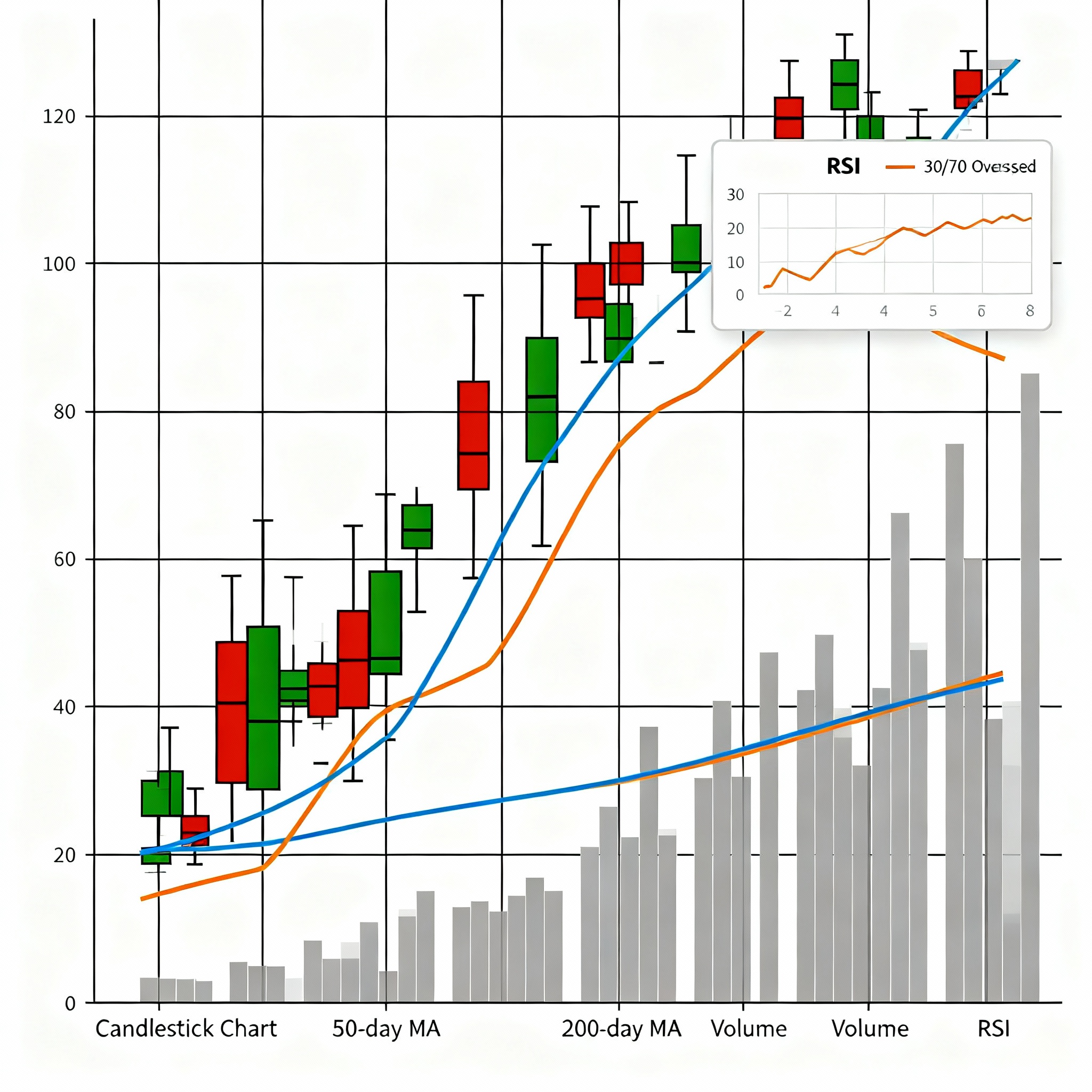

Mastering Technical Analysis: A Complete Guide to Understanding Stock Price Movements
Investing is both an art and a science, and technical analysis sits at the heart of this balance. Whether you are a short-term trader or a long-term investor, understanding technical analysis helps you make informed decisions based on price behavior rather than just company fundamentals. It reveals the psychology of market participants through data patterns reflected in price and volume movements.

What is Technical Analysis?
Technical analysis is the method of evaluating stocks based on their market activity — primarily price and volume. Unlike fundamental analysis, which assesses a company’s intrinsic value using financial statements and business performance, technical analysis focuses on identifying trading opportunities through statistical trends and chart patterns.
At its core, technical analysis assumes three key principles:

- Market action discounts everything: All known and anticipated information is already factored into the price.
- Prices move in trends: Stock prices move in uptrends, downtrends, or sideways patterns, which can be identified and traded.
- History tends to repeat itself: Market participants often react to similar situations in predictable ways, creating recurring price patterns.
Through these principles, technical analysis seeks to anticipate future price movement using historical data.
Essential Terms in Technical Analysis
To master technical analysis, it’s vital to know the most common terms and concepts traders use daily.
- Trend: The general direction in which a stock’s price is moving — upward (bullish), downward (bearish), or sideways (range-bound).
- Support and Resistance: Support is a price level where buying interest prevents further decline, while resistance is a level where selling pressure halts an advance.
- Moving Average (MA): The average of past prices over a specific period used to smooth out short-term fluctuations. Common types include the Simple Moving Average (SMA) and Exponential Moving Average (EMA).
- Relative Strength Index (RSI): A momentum oscillator that measures the speed and change of price movements, commonly used to identify overbought or oversold conditions.
- Moving Average Convergence Divergence (MACD): A trend-following indicator showing the relationship between two moving averages of a stock’s price. It generates buy or sell signals based on crossovers.
- Bollinger Bands: These measure price volatility by plotting bands around a moving average. When prices move close to the bands, it indicates potential overbought or oversold zones.
- Volume: Represents the total number of shares traded during a specific period. Increasing volume often confirms strong price movement in the direction of the trend.
- Candlestick Patterns: Visual representations of price activity that reveal market sentiment. Patterns like Doji, Hammer, and Engulfing can indicate potential reversals or continuations.
Understanding these concepts empowers traders to interpret charts more effectively and make timely decisions.
How to Perform Technical Analysis of a Stock
Performing technical analysis involves both observation and systematic study of charts and indicators. Here’s a step-by-step process to help you conduct an effective analysis.
Step 1: Identify the Trend
Start by determining the general direction of the stock. Use indicators like trendlines, moving averages, or the Average Directional Index (ADX) to recognize whether the stock is in an uptrend, downtrend, or consolidation phase. Always trade in the direction of the major trend.
Step 2: Analyze Support and Resistance Levels
Mark the key price levels where the stock has reversed previously. These zones often become decision points where buying or selling pressure intensifies. A break above resistance can signal a bullish rally, while a drop below support can indicate a bearish move.
Step 3: Apply Moving Averages
Moving averages help filter out noise from short-term fluctuations.
- The 50-day SMA and 200-day SMA are widely followed by traders.
- When the short-term average (50-day) crosses above the long-term average (200-day), it forms a Golden Cross, a bullish signal.
- Conversely, when it crosses below, it forms a Death Cross, a bearish indicator.
Step 4: Use Momentum Indicators
Momentum indicators such as RSI or MACD help assess whether a stock is overbought or oversold.
- An RSI reading above 70 can mean the stock is overbought, while below 30 may suggest it’s oversold.
- The MACD line crossing above the signal line indicates bullish momentum; crossing below suggests bearish momentum.
Step 5: Study Chart Patterns
Patterns form due to repetitive price actions influenced by investor behavior. Popular patterns include:
- Head and Shoulders: Signals a reversal from bullish to bearish.
- Double Bottom: Indicates a strong support level and potential uptrend start.
- Triangles: Suggest continuation or breakout from consolidation zones.
Recognizing these patterns early can help predict price movements with significant accuracy.
Step 6: Confirm with Volume
Volume confirms the strength of price movements. Rising volume during price increases suggests strong buying demand, while falling volume can signal weakening interest. Breakouts supported by high volume are usually more reliable.
Step 7: Combine Multiple Indicators
No single indicator works perfectly in isolation. Combine trend indicators (like moving averages), momentum oscillators (like RSI), and volume studies to create a balanced technical view before taking a position.
Role of Technical Analysis in Trading Strategy
Technical analysis is used in different timeframes to suit various trading styles:
- Day Traders: Focus on short-term price movements using intraday charts of 1-minute to 15-minute durations.
- Swing Traders: Hold positions for a few days or weeks, relying on daily or 4-hour charts.
- Position Traders: Hold trades for months and analyze weekly or monthly charts.
By aligning the trading style with the right timeframe and technical tools, traders can maintain discipline and manage risk effectively.
The Limitations of Technical Analysis
While technical analysis is powerful, it’s not foolproof. Market movements can be influenced by unexpected news, global events, or investor panic — factors that charts cannot predict. Indicators may also produce false signals during periods of low liquidity. Therefore, it’s wise to combine technical analysis with proper risk management and a clear trading plan.
Conclusion
Technical analysis transforms historical price data into actionable insights. With consistent application and disciplined trading, anyone can learn to forecast probable price movements rather than relying on guesswork. Mastering chart interpretation, indicator analysis, and pattern recognition helps traders make smarter, data-backed investment decisions.